
Lorenzo Biscontin
The wine industry, Champagne aside, is characterized by a shortage of strong brands, both globally and in italy. In a recent article, Jamie Goode lists the world’s still wine brands and states, “Beyond Champagne, we have great still wine brands. Jacob’s Creek, Hardy’s, Wolff Blass, Penfolds, and YellowTail are well-known Australian brands. From Chile, Concha y Toro. From Argentina, Trapiche and Catena. From California, Opus One, Mondavi, Sutter Home, Barefoot, and Gallo are all easily recognizable even by casual wine drinkers. Europe has fewer big brands, but Torres in Spain and Whispering Angel from Provence enjoy widespread recognition.
Historically, Portugal has played a major role in the branded wine industry, with Mateus and Lancers winning fans with their distinctively packaged rosés. And Germany’s Blue Nun was a staple for many consumers in the 1970s and 1980s.”
If we were to objectively define a “strong brand” as one with spontaneous awareness by at least 25% of wine consumers, I doubt that some of these brands could be actually called “strong” even in their country of origin. But even assuming Goode’s list is correct, this is a rather small number, given the size of the global market.
If we look at the Italian market, the only strong still wine brand is probably Tavernello. Twenty years ago, I commissioned research on brand awareness among wine consumers aged 18 to 65. The top industrial brand (excluding appellations and grape varieties) had a spontaneous awareness of 6%, but this was coupled with a poor reputation.
The reason commonly cited for this lack of strong wine brands is production fragmentation, that is, the small size of wineries that prevents them from acquiring the financial and human resources necessary to build strong brands.
After twenty years working in this sector, I’m becoming convinced that production fragmentation is the consequence of consumer behavior toward wine as a category.
And this conviction comes from my previous experience in the cured meats sector.
Before I explain further, however, it’s necessary to share some definitions.
Brand:
A brand is any verbal, graphic, or physical sign to which people associate values that create a pre-configuration of the expected benefits of using the product.
This means, for example, that a label is not necessarily a brand.
Important semantic note: In this article, I will consider the terms “brand” and “trademark” as perfect synonyms to express this concept, reserving the term “brand” for industrial/private brands and “trademark” for appellation and collective brands.
Strong brand:
A brand defined as above, which also has enough power to enjoy a competitive advantage in terms of volumes sold/sales price/market loyalty compared to competitors.
In the introduction to this article, I established a minimum (arbitrary) threshold of 25% spontaneous awareness among wine consumers. In reality, a more accurate reasoning can be achieved using the “Knowledge x Reputation” matrix found below.
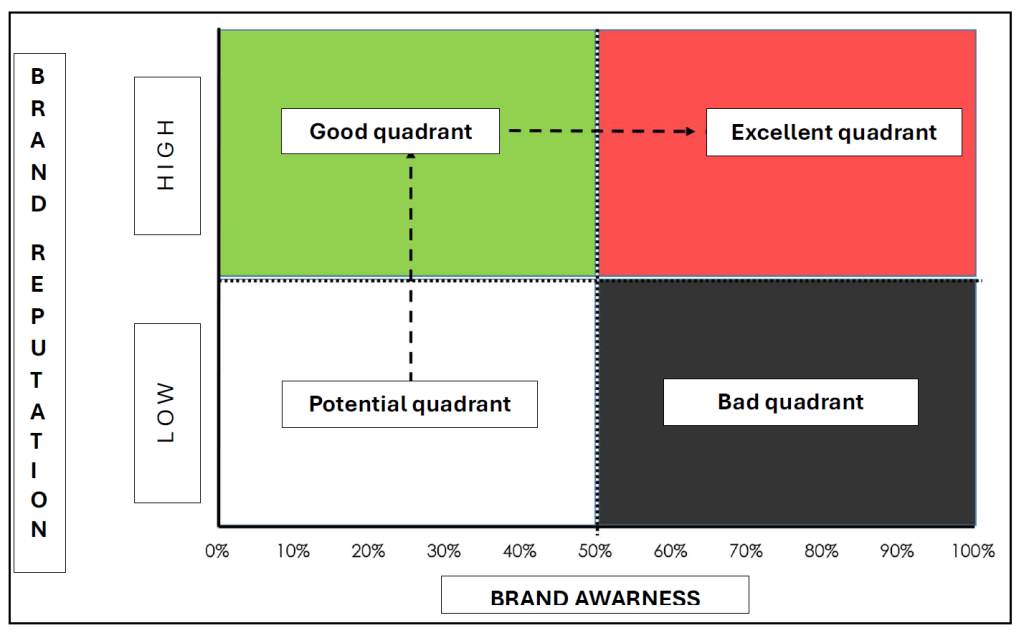
I realize this matrix should be explained in more detail, but it would become an article on branding and we would be going off-topic.
I’ll just point out two things:
– the clear boundaries given to the quadrants are for explanatory purposes only, and the matrix dimensions should be read as a continuum, meaning there is no substantial difference between a brand with 49% awareness and one with 51%.
– Awareness and reputation are the two minimum, essential dimensions of a brand. All actions taken and the results achieved can essentially be traced back to either reputation and/or awareness. Neither of these two dimensions can be eliminated without losing key brand information.
The concepts expressed above are easily understood if one considers the Champagne industry, which has always been based on the construction and development of Maison brands, in addition to the appellation trademark.
The example of cured meats and the idea of the concept of a weak brand.
At the end of the 1980s, some multinational food companies looked at the Italian cured meats sector because they saw a seemingly very interesting situation where a good market size corresponded to an underdevoleped sector, characterized by high fragmentation and widespread family ownership. At the time, the market leader was Fiorucci with a share of just 5%.
They then entered by acquiring already well-established companies and used their financial resources to implement a classic strategy of market share “purchase”. Focus on super and hypermarket chains, heavy investments in listings, intense promotional activity, and structured sales networks with employees to monitor the market (instead of traditional multi-mandate agents).
The idea was that within one or two years, this strategy would marginalize competition and foster customer and consumer loyalty.
What happened instead was that when promotional activity tapered off, sales and turnover also declined, customers demanded listing renewals, and after a few years, all the foreign multinationals withdrew from the Italian cured meats sector, reselling the companies they had acquired with much higher revenues but with losses for the first time in their history.
Why didn’t the strategy work? Because when consumers no longer found the products on sale, they simply switched to a competing product they perceived as essentially equivalent. And did the same thing when their usual brand was delisted.
That is, when people buy cured meats, they’re only partially interested in the brand, while they’re primarily guided by other factors: for example, “preservative-free,” “lactose-free,” appellation and origin, the type of salami (Hungarian, Milanese, Mantuan, Corallina, etc.), the presentation, etc.
I was marketing manager in two main cured meats producers from 1994 to 2000 and to navigate this scenario I began to think in terms of a “weak brand” sector, meaning one in which the brand’s ability to shift preferences comes only after a whole other set of factors.
More than thirty years have passed, you might say. And cured meats are sold sliced on the spot.
The current cured meats sector is worth €9.6 billion, of which €2.5 billion is exported (Italian wine is worth €14 billion, of which €7.8 billion is exported), produced by approximately 3,000 cured meat producers (there are 30,000 wineries), and fixed weight products (i.e., pre-sliced and packaged) account for a 51% market share.
In theory, this is an ideal scenario for strong brands to emerge. Yet the market leader is Gran Terre with a 19% share, but this is a misleading figure because it groups together several brands such as “Casa Modena,” “Parmacotto,” “Senfter,” and “Alcisa.” The second company is Beretta with 12%, an historic leader in the sausage sector, where branding and packaging have always played a significant role.
Even a company like Rovagnati, which invented the branding of cooked ham, only holds a 3% market share.
What do cured meats have to do with wine?
I’ve spent all this words describing the situation in the cured meats market because I see many similarities with what happened in the wine sector.
In the 2000s, wine was a highly fragmented industry, with a positive market trend in some major markets (primarily the US and UK), and a lack of strong brands.
This situation favored the entry of multinational spirits companies into the sector, which at the time were often in the spotlight due to problems caused by irresponsible alcohol consumption (primarily drink & driving).
We’re talking about companies like Diageo, Pernod Ricard, and Brown Forman worldwide, while in Italy we had the significant examples of Campari, which even created the Campari Wines division to manage its portfolio of still wines (Sella & Mosca was the main brand), and Ilva Saronno with its Duca Wines division, which includes Duca di Salaparuta, Corvo, and Florio.
Today, with the exception of Ilva Saronno, all these companies have sold their wine brands and operations due to the inability to create brands consistent with their business model and capable of guaranteeing sales and/or margins comparable to the rest of their portfolio.
Campari is perhaps the most striking example: while it was owning the Spritz category with the brand Aperol, it divested from the Cinzano brand until it sold it, despite it being a historic sparkling wine brand, including Prosecco, which is the main ingredient in Spritz in quantitative terms.
These are all companies that certainly cannot be said to lack marketing expertise, nor operational and financial capacity.
Yet they have been unable to build strong brands in the wine sector.
Similar reasoning can be applied to major global and Italian wineries. Neither size nor expertise can be cited as constraints for brand creation, but the vast majority operate with a multi-brand approach (with weak brands) that leverages distribution power and production efficiency to achieve economic and financial results.
The more I analyze it, the more wine appears to me to be a weak-brand sector due to market sentiment, not due to wineries’ shortcomings.
Marketing in weak-brand sectors.
In weak-brand sector, marketing principles don’t change; the context and therefore the execution do.
Greater importance of commercial intermediaries, and therefore of trade marketing.
Trade should be considered the primary customer, not a mere logistical conduit.
This concept is shared by wineries in the case of on-trade operators due to the significant influence they have in directing consumers (although in practice the actions undertaken are more promotional than image-building/brand equity). For buyers in the off-trade channel, it’s less intuitive and therefore must be considered even more carefully.
Greater importance of product appearance.
Numerous studies have proved the importance of the bottle’s image in consumer choices. In addition to being eye-catching, this image must convey the brand’s objective positioning so as to be consistent with other activities (and vice versa).
Given the importance of trade, appearance must be considered at any level. How many bottles with carefully designed labels are placed in anonymous cartons? How many bottles also have the logo on the top of the capsule, thus providing an element of recognition even when they’re lying around in the cellar (service) and showing a corporate culture of product care (positioning)?
From precision targeting to community management.
In a weak-brand sector, it’s necessary to target audiences, and consequently the offering, with the utmost precision.
Note that precision targeting doesn’t necessarily mean narrow audience.
For example, when I was at Levoni (cured meat producer), we targeted traditional delicatessens, the company’s historic channel, which had been left uncovered by some competitors who had instead decided to enter in super and hypermarkets chain. The determining factor, however, wasn’t the size of the store, but rather the fact that these stores wanted to differentiate themselves through the enhancement and quality of their cured meats counter.
This targeting allowed us to adapt to the reduction in the number of traditional delicatessens and grocers in favor of large-scale retail trade, while maintaining consistency in our offering in terms of product, prices, discounts, and communication.
Targeting was also precise in terms of building a direct relationship between the company and the customer, who became part of a de facto community. Each new customer together with their first order received a welcome letter signed by the owner (we’re talking about the tenth largest Italian cured meat company in terms of revenue and the first in terms of overall margin) and some useful service materials for their business, which simultaneously increased brand visibility at the point of sale.
Of course, this community also included agents, despite having all multi-mandate agents, who periodically organized trips to the company for groups of their customers.
This goes to show that “community is as community does” regardless of whether the company has a community manager or uses digital tools.
To create and grow a community, the basic principle is as simple as it is difficult to apply consistently with discupline: focus on what interests the community members, not what interests you. If we truly have a shared vision and purpose, our interests will ultimately converge.